The short answer
Why should associations read this chart from the bottom?
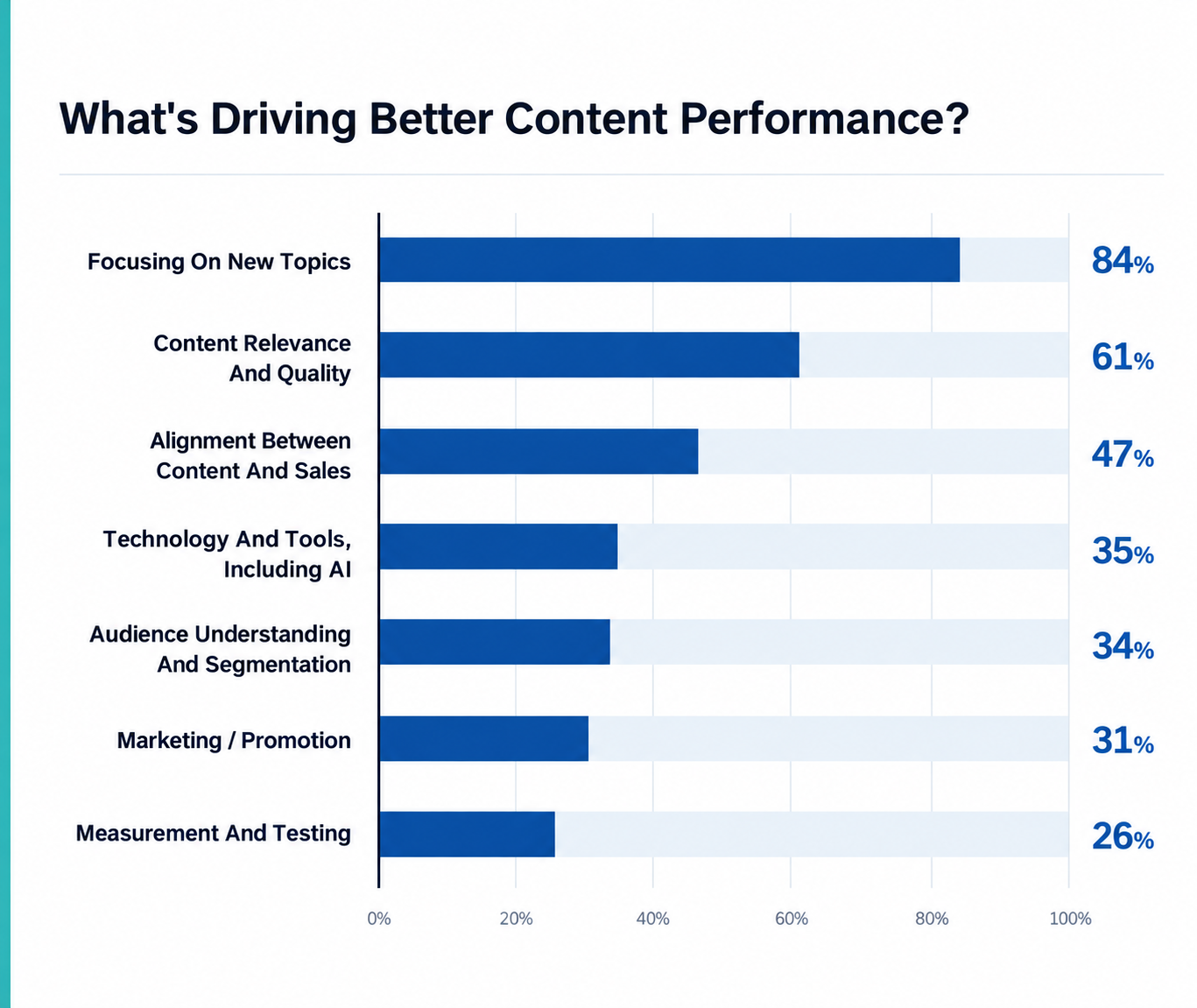
A chart has been circulating this month from NP Digital, based on a survey of 100 companies, asking what is driving better content performance.
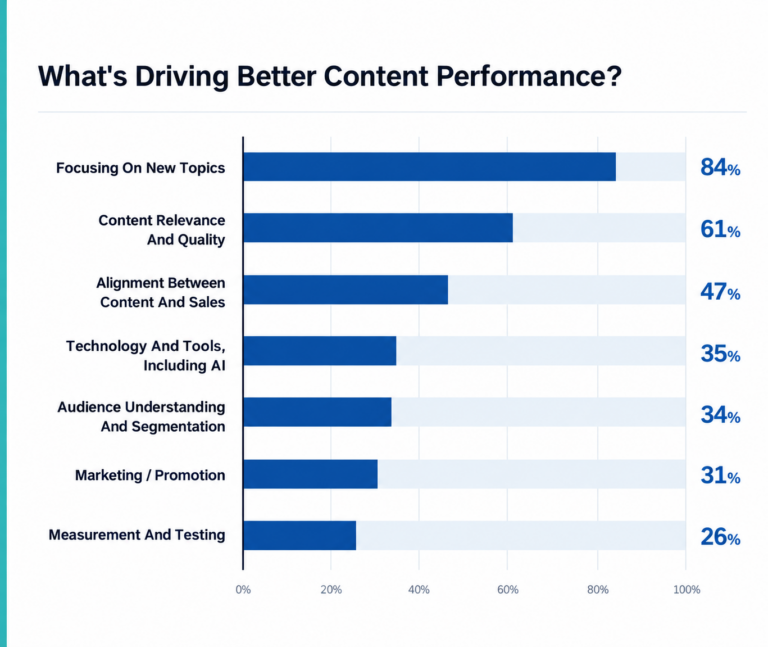
Most of the marketing world will look at that top bar and conclude they need more new topics. If you run marketing for an association, we think you should read the chart from the bottom.
What did the survey actually measure?
It is worth being precise about this, because the distinction changes what you do with it.
The survey did not measure which activities cause content to perform. It measured what marketers say when asked to explain an improvement they have already seen. Those are two different things. Self reported attribution rewards whatever is most visible and most recent. Publishing on a new topic is highly visible. You can point to it in a meeting. Rebuilding your segmentation is invisible, slow, and nobody thanks you for it in the quarter you do it.
So the 84% is not evidence that new topics are the strongest lever. It is evidence that new topics are the easiest lever to notice yourself pulling.
Why do associations sit differently?
Look at the fifth bar. Audience understanding and segmentation, at 34%.
For a corporate marketer that number is defensible. They are inferring who their audience is from behaviour, third party data, and guesswork, and the inference is expensive and imprecise. Segmentation is genuinely hard for them, so it stays near the bottom of the list.
You are not in that position. You know your audience by name.
Your AMS holds discipline, job title, career stage, chapter, committee service, certification status, join date, renewal date, lapse history, and every session your members have ever attended. Your LMS knows what they are studying. Your registration system knows who came alone and who brought their team. A commercial brand would pay a great deal of money for a fraction of that, and would still only have a probabilistic version of it.
That is the asset. The survey ranks it sixth out of seven, and if you accept that ranking you are accepting a priority list built for organisations that do not have what you have.
What is the new topics trap?
There is a specific way this goes wrong for associations.
The pressure to keep finding new subject matter pushes content further and further from the thing your members joined you for. You end up publishing broad professional interest pieces that sit somewhere between a trade magazine and a LinkedIn feed, competing with publishers who do that for a living and do it faster. The traffic may go up. Membership does not, because none of it is anchored to the reason anyone pays you a renewal.
Meanwhile the content that actually earns a renewal is usually not new at all. It is the same core material, made relevant to a much narrower group of people at the moment it matters to them. The certification pathway explained to someone eight years into practice rather than to everyone. The regulatory update written for the two chapters where the rule actually changed. The case study aimed at first time attendees deciding whether next year’s conference is worth the travel budget.
That is not a new topic. It is an old topic, aimed properly. And it is the least glamorous work on the entire chart.
What does alignment between content and sales mean for associations?
The third bar, at 47%, needs rewording before it means anything to you. Associations do not have a sales pipeline in the sense the survey intends. You have four or five revenue lines that behave very differently: membership, events, certification and education, sponsorship and exhibition, and in some cases publishing or advocacy.
Content aligned to one of those is often actively unhelpful to another. A free, thorough, technically excellent article can strengthen membership and quietly undercut the paid course covering the same ground. That tension is real and it does not resolve itself. It resolves when someone decides, deliberately, which revenue line a given piece of content is serving, and accepts the cost to the others.
Very few associations we work with have made that decision explicitly. Most have made it by accident, one article at a time.
What should associations do first?
If you want a practical order of work, it looks close to the reverse of the chart.
- Define six to eight member segments you can actually address. Not personas invented in a workshop. Segments you can pull from your AMS on a Tuesday morning and email the same afternoon. If you cannot query it, it is not a segment.
- Map your existing content to those segments. You will find heavy duplication for one or two groups and nothing at all for the rest. That gap is usually worth more than any new topic on your editorial calendar.
- Assign each content stream to one revenue line. Membership, events, certification, sponsorship. Write down which one, and what it is allowed to give away.
- Set a measurement window longer than a quarter. The bottom bar on that chart, measurement and testing at 26%, is last for the same reason segmentation is fifth. It takes time to pay off and it is easy to skip. Renewal and registration cycles are annual. Judging content on 30 day traffic will always point you back towards new topics, because that is the only thing that moves in 30 days.
- Then look for new topics. Not first. Fifth. By that point you will know which gap a new topic is filling and which member it is for.
How reliable is the data itself?
One hundred companies, self reported, published by an agency. That is a directional signal, not a finding, and none of the respondents were associations. We are treating it as a useful prompt for a conversation rather than as evidence. We would encourage you to treat any survey shared as a chart the same way, including ours.
Why Associations Should Start at the Bottom
The advantage you have over commercial content teams is not budget, speed, or subject matter. It is that you know exactly who is reading and exactly what they are trying to achieve in their career. Almost nothing in that chart is built around that advantage.
Start at the bottom.
Kabloom works with associations on digital marketing built around member data rather than around content volume. If any of the above sounds like your current situation, we are happy to talk it through.
Frequently asked questions
What is driving better content performance, according to the NP Digital survey?
In NP Digital's survey of 100 companies, respondents credited focusing on new topics (84%), content relevance and quality (61%), alignment between content and sales (47%), technology and tools including AI (35%), audience understanding and segmentation (34%), marketing and promotion (31%) and measurement and testing (26%). None of the respondents were associations.
Does the survey prove that new topics improve content performance?
No. The survey measured what marketers say when explaining an improvement they have already seen, not what caused it. Self reported attribution favours the most visible and recent work, so the 84% shows new topics are the easiest lever to notice, not the strongest.
Why is audience segmentation more valuable for associations than for corporate marketers?
Corporate marketers infer their audience from behaviour, third party data and guesswork. Associations know their members by name. Their AMS, LMS and registration systems hold career stage, certification status, renewal dates, lapse history and attendance, which gives associations a far more precise basis for segmentation.
What kind of content helps associations win renewals?
Content that earns renewals is usually existing core material made relevant to a narrower group of members at the moment it matters. Examples include a certification pathway explained for mid-career members, a regulatory update written for the chapters affected or a case study aimed at first time attendees weighing next year's conference.
How should associations align content with revenue?
Associations should assign each content stream to one revenue line, such as membership, events, certification or sponsorship, and write down what that content is allowed to give away. Without this decision, free content can strengthen one revenue line while undercutting another, such as a paid course.
How long should associations measure content performance?
Longer than a quarter. Membership renewal and event registration cycles are annual, so judging content on 30 day traffic will always favour new topics, because they are the only thing that moves in that window.
Should associations stop publishing content on new topics?
No, but new topics should come last. Define member segments, map existing content to them, assign content to revenue lines and set a longer measurement window first. By then it is clear which gap a new topic fills and which members it serves.