The short answer
What is RaaS (Results as a Service)?
Every few years the events and marketing industries rename the same argument. This time the name is worth keeping, because the thing underneath it is real.
We call it RaaS. Results as a Service. An association buys a defined result, and the partner delivering it carries part of the financial consequence of whether it arrives. Not a quantity of effort. Not a deck. A number agreed before the work started, and a fee that moves with it.
For forty years the alternative held because it was administratively simple. The client bought people and hours, and every question about whether the meeting filled or membership grew stayed on the client’s side of the ledger. That settlement is ending, and the reason is arithmetic before it is philosophy.
Why has the old agency model stopped working?
When a task that took ten hours now takes two, an agency billing by time earns a fraction of what it used to for an identical result. Research synthesis, copy iteration, reporting, media optimisation and asset versioning have all compressed, which leaves any business built on junior production and time based billing structurally exposed.
The sector numbers show where the gain went. eMarketer’s Ad Agency Trends 2026 report put worldwide ad spending up 8.6% in 2025 while agency holding company revenues fell 1.2%. Demand up, supplier revenue down. Clients have worked out why. Productive’s 2025 survey of more than 180 agencies found almost one in three had been asked for an AI discount, and only 13% had actually lowered prices.
The largest player in the industry has now put a number on the response. WPP’s chief financial officer Joanne Wilson has disclosed performance linked fees running at 20% to 25% of net sales, describing a shift away from pure time and materials toward output and performance based pricing appearing both in pitches and in existing relationships.
That is the industry arriving, slowly, at RaaS.
Why do associations need RaaS more than anyone?
This is not a fashion argument. Naylor’s benchmarking has put revenue beyond dues as the top financial challenge for associations three years running, and ASAE’s own commentary has been blunt about how exposed organisations are when they lean on event sponsorship that evaporates the moment attendance dips.
Attendance is where that exposure lives, and the data is noisier than most people quote it. CEIR’s Q3 2025 index put attendees 12.3% below the 2019 benchmark while exhibitors had recovered to within 5%, but the Q2 2025 attendance shortfall was only 3.7%, and CEIR itself cautions that Q3 is traditionally the weakest quarter of the year. Two quarters, two very different stories.
That volatility is the point. If an association cannot say with confidence what its own attendance trend is, it certainly cannot say what its marketing produced. Which is the whole problem RaaS exists to solve, and also the reason it is harder to implement than it sounds.
What are the three levels of RaaS?
Half of Kabloom’s clients now operate with some level of outcome based remuneration. RaaS is a ladder, and the first rung carries less risk for the association than anything a traditional agency offers.
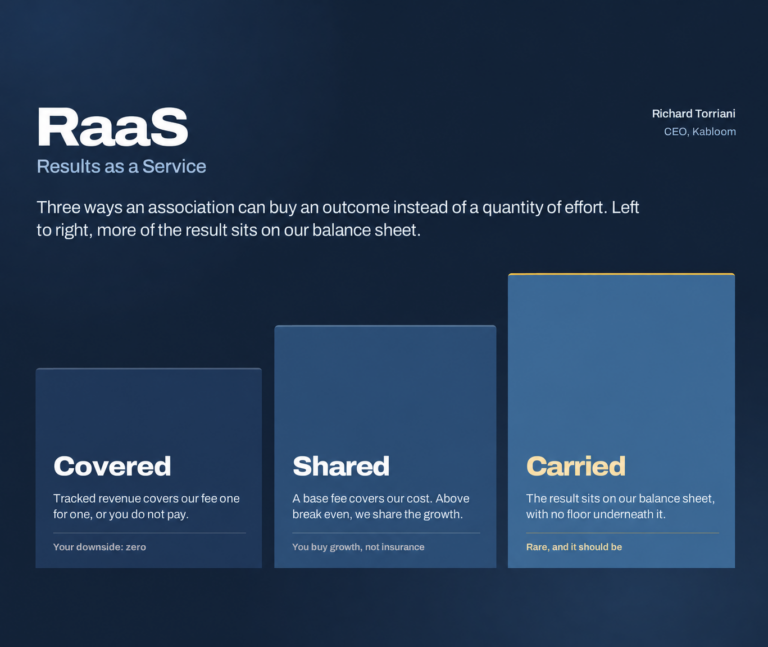
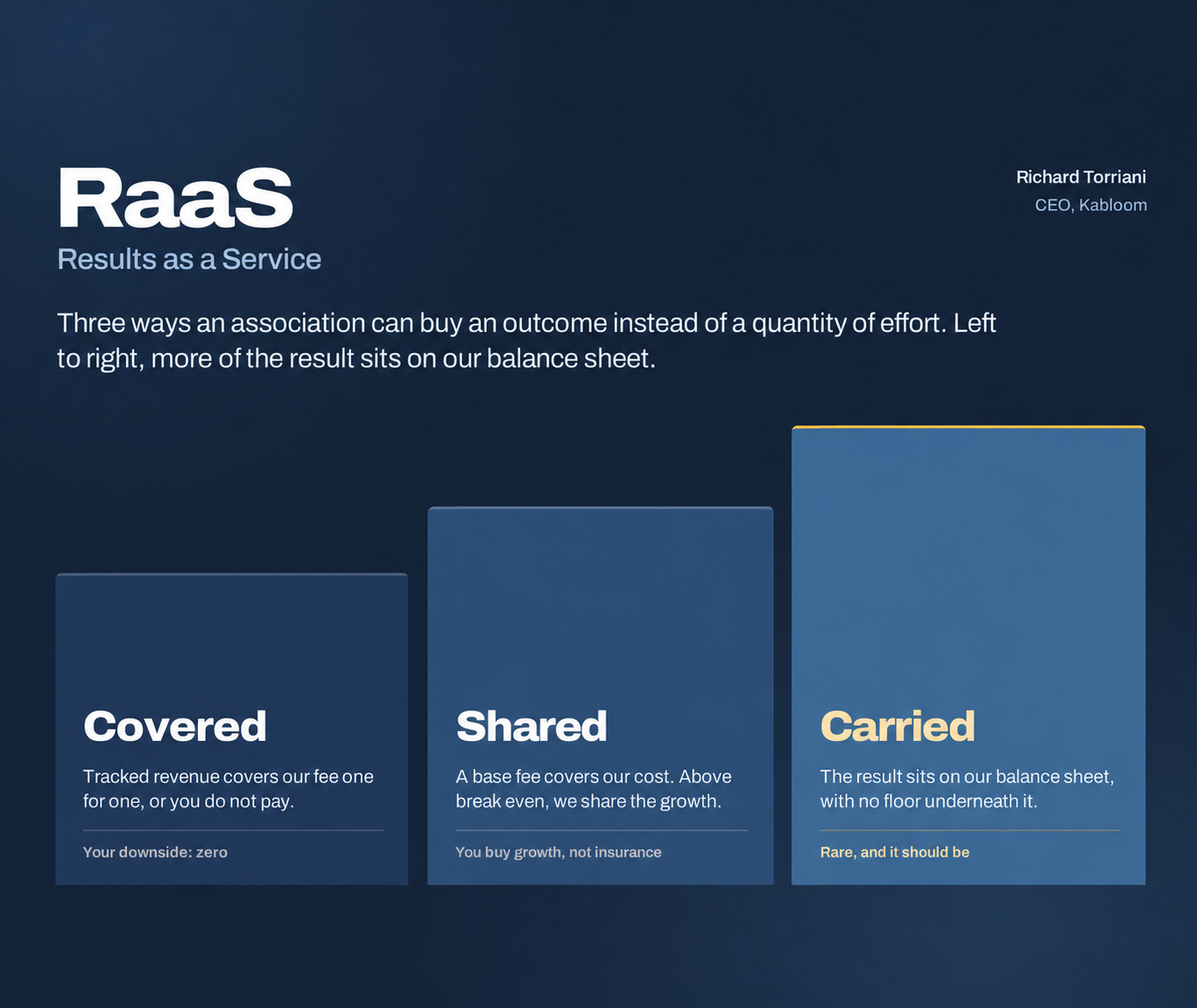
Level one, Covered. Tracked revenue covers our fee one for one, or the client does not pay. Tracked means UTM coded digital campaigns followed through into the registration or membership platform, so a registration or a joining fee resolves back to the campaign that produced it inside the client’s own system. The association’s downside is capped at zero. This is where most relationships start, because it removes the argument about whether to try at all.
Worth being plain about what that method gives away. It credits us only for what the data can prove, and hands back everything that arrived through word of mouth, a referral, or a speaker posting to their own network. It is conservative in the client’s favour by design. The converse also needs watching: a member who was always going to renew clicks a campaign email on the way to doing it, and the code records a conversion the campaign did not cause. Agreeing a baseline for that at the start, before either side has a reason to argue about it, is the difference between a clean number and a difficult meeting in month eleven.
Level two, Shared. A base fee covering the cost of operating, with genuine upside tied to an agreed number above the break even line. The association stops buying insurance and starts buying growth. The base matters, because outcome work is performed first and paid on results that land months later, and most partners are not capitalised to wait. Carrying that gap is a real cost, and it is the reason level one is rarer in this industry than the marketing literature suggests.
Level three, Carried. The result sits on the partner’s balance sheet with no floor. Rare, and it should be. Congress organisers have reached the same place from a different direction, with more PCOs now taking a financial stake in the events they run, on the reasoning that it motivates them to deliver more attendees, sponsorship and exhibitors, as the World PCO Alliance has described.
It exists in the conference world too. Event Tech Live reported in March 2026 on a New York conference, frustrated by passive execution and no accountability for ticket sales, that replaced its traditional agency with one working on performance terms and no flat fee, tied to attendee acquisition. The engagement grew from a four figure deal to a six figure relationship.
Where does RaaS break?
Anyone selling this as risk free is selling something.
Attribution is the first wall, and the honest answer is that it is only solvable in places. Digital acquisition is one of those places, because a UTM coded click resolving into a registration record in the client’s own platform is a closed loop both sides can read. Brand, reputation and the slow work of making a profession want to gather are not, and no measurement stack will make them so. This is why the fee guarantee attaches to the part of the work where causation is legible, and why anyone offering the same guarantee across an entire programme is offering something they cannot honour.
Authority is the second. A partner paid on results needs the decision rights that affect those results, and workable contracts carve out explicitly which decisions sit where. Accountability without authority produces someone fighting for permission to do the thing they are already carrying. In associations this is genuinely hard, because boards and committees own decisions sitting directly on the causal path.
The metric itself is the third. A partner can hit its number with tactics that technically deliver and quietly damage the brand, and a vendor who hits revenue by discounting the core product has delivered nothing worth having. The association version is obvious: registrations bought cheaply from the wrong audience will clear the target and hollow out the exhibition floor next year.
And the honest state of play is early. WPP’s chief executive Cindy Rose told Digiday in August 2026 that just one client had adopted the outcome model and that the evolution will take years, while holding that time and materials is probably not sustainable in the long run because AI lets the work be done faster with fewer people. Both halves of that are true at once, and the gap between them is the opportunity.
What should associations ask a RaaS partner?
- Ask any partner for their average registration to attendance ratio across recent programmes, in writing, and the average rather than the best case.
- Ask which decisions they need to own to stand behind a number.
- Ask how the baseline gets set and who verifies it.
- Ask what happens if the target is hit by means you would not have chosen.
- Ask them to price strategy separately from production, because the value of those two things is diverging quickly.
Why the Measurement Work Comes First
Then one for yourself. Bizzabo’s 2026 State of Events Benchmark Report found 40% of organisers still reporting difficulty proving event ROI, down from 70% a year earlier. Real progress. But an organisation that cannot describe a good outcome cannot buy one, whatever the contract says, and no guarantee survives contact with a client whose platform cannot tell it where a registration came from.
The industry is going to arrive at RaaS either way. The associations that do the measurement work early will arrive holding the better end of the bargain.
Frequently asked questions
What is RaaS (Results as a Service)?
RaaS is a commercial model where an association buys a defined result rather than a quantity of effort, and the partner delivering it carries part of the financial consequence of whether the result arrives. The fee is tied to a number agreed before the work starts.
Why are agencies moving away from time-based billing?
AI has compressed tasks such as research synthesis, copy iteration, reporting and media optimisation, so billing by time earns less for the same result. eMarketer reported ad spending up 8.6% in 2025 while agency holding company revenues fell 1.2%, and WPP has disclosed performance linked fees at 20% to 25% of net sales.
What are the three levels of RaaS?
Covered means tracked revenue covers the partner's fee one for one, or the association does not pay. Shared means a base fee covering operating costs, with upside tied to an agreed number above break even. Carried means the result sits on the partner's balance sheet with no floor, which is rare.
How is revenue tracked in a RaaS model?
Revenue is tracked through UTM coded digital campaigns followed into the association's registration or membership platform, so each registration or joining fee resolves back to the campaign that produced it. Both sides should agree a baseline at the start for members who would have renewed anyway.
What are the risks of RaaS for associations?
There are three main risks. Attribution is only solvable for work such as digital acquisition, not brand or reputation. A partner paid on results needs decision rights that boards and committees often hold. And a target can be hit with tactics that damage the brand, such as registrations bought cheaply from the wrong audience.
Why do associations need RaaS?
Revenue beyond dues has been the top financial challenge for associations three years running, according to Naylor's benchmarking, and attendance data is volatile. CEIR put Q3 2025 attendance 12.3% below the 2019 benchmark against a 3.7% shortfall in Q2. RaaS ties marketing spend to results an association can verify.
What should associations ask a partner offering performance-based fees?
Ask for their average registration to attendance ratio in writing, which decisions they need to own, how the baseline is set and verified, what happens if the target is hit by means you would not choose and whether they price strategy separately from production.