The short answer
Your congress page competes on its own
AEO works page by page, not site by site. When someone asks an AI assistant “when and where is the 2026 clinical nutrition congress“, the engine does not reward your domain for its reputation. It finds the single clearest, best-structured page answering that question and quotes it.
This is the most important difference between AEO and SEO, and it has an uncomfortable consequence for associations. Your homepage can be entirely respectable while your congress registration page, the page that actually drives revenue, is invisible to AI engines. Because analytics report sessions rather than citations, nothing in your reporting would tell you.
Existing SEO tools measure the wrong unit
Traditional SEO platforms are built around domains, keywords and rankings. None of those tell you whether a machine can extract your event dates, identify your organisation, or find a direct answer on the page.
We needed a different unit of measurement: one page, assessed on whether an answer engine can parse it. So we built one that judges a page on its own evidence and ignores anything it might know about the brand from elsewhere. An audit that quietly borrows credibility from your LinkedIn profile tells you how well known you are, not whether that page can be cited.
The failure is structural, not editorial
The pages we examine usually have strong copy written by people who know their field. What they lack is machine-readable structure. Four patterns recur across association and congress websites.
Congress pages rarely declare themselves as events. Schema.org includes an Event type with properties for start date, end date, venue and location. It exists precisely so a machine can answer “when and where”. Most congress pages we audit do not use it. The dates sit in a banner or a countdown widget, perfectly legible to a delegate and invisible as structured data.
Key content sits behind JavaScript. Event sites lean on page builders, animated counters and tabbed programme viewers. A crawler that does not execute JavaScript can retrieve a page of several hundred kilobytes and find only a few thousand characters of readable text. The programme and speaker list are present for humans and absent for the machine.
Nobody is credited. Associations are among the most genuinely authoritative organisations in their fields. Yet their pages often carry no named author, no credentials and no publication date, so that authority is never transmitted.
Answers exist but are not formatted as answers. Abstract deadlines, registration categories, accreditation and visa guidance usually live in a PDF or buried in prose. Reformatted as visible questions with direct answers, the same material becomes citable.
Audits belong before launch, not after
AEO signals are far easier to build into a page during development than to retrofit once a campaign is live. That only works if auditing is quick and free enough to be a routine pre-launch step rather than a special project. That requirement shaped the tool more than any other.
We use it internally, so we are sharing it
We built the AEO Monitor to check client pages before campaigns. Keeping it internal made progressively less sense. The association and events sector is navigating this shift with little practical guidance, and a free diagnostic is more useful than another opinion piece.
How the AEO audit tool works
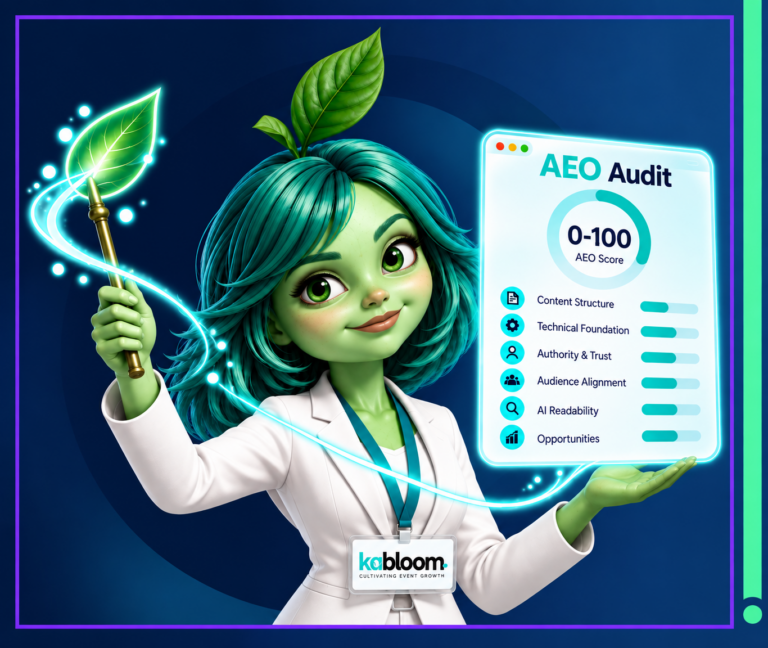
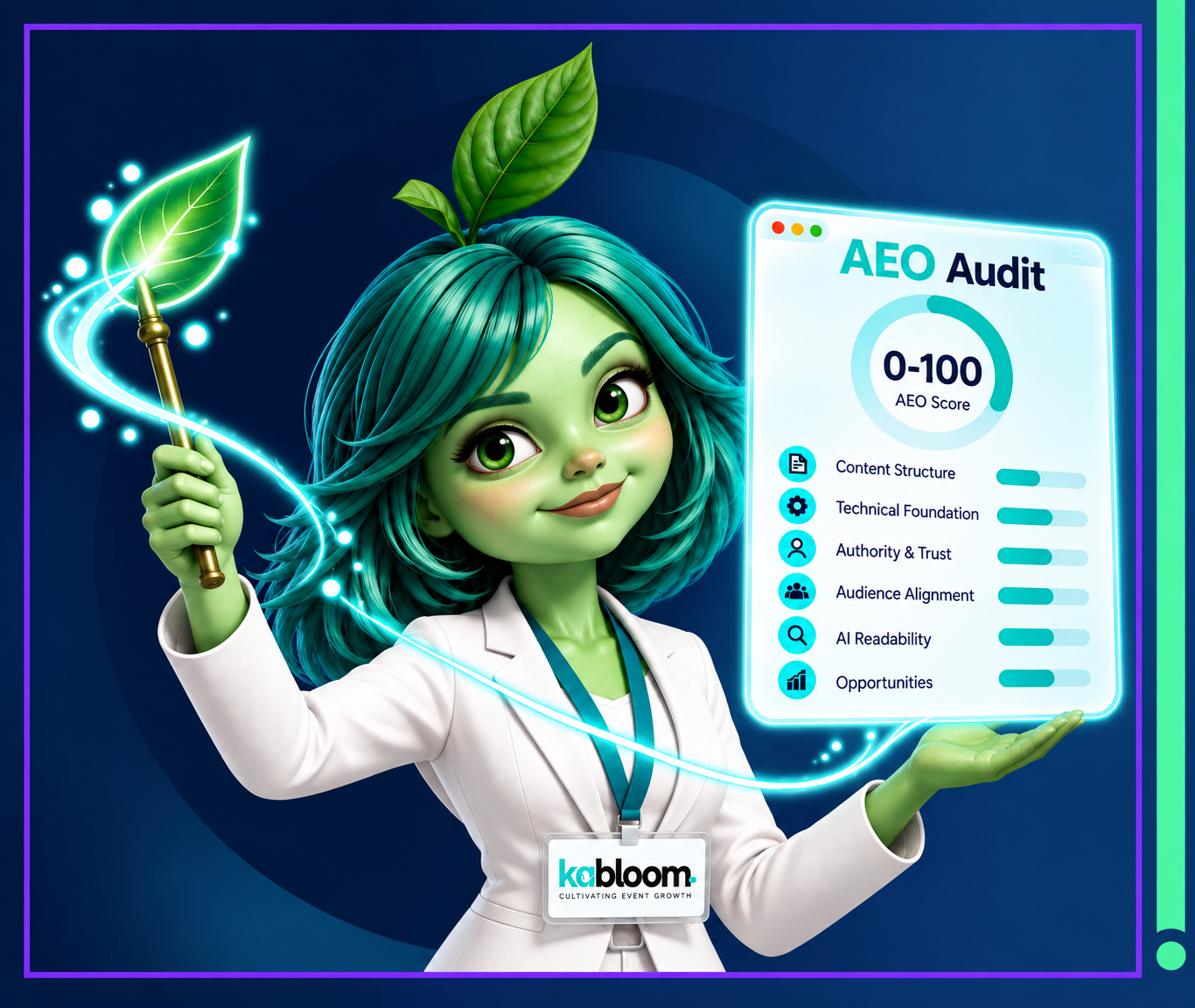
The tool fetches one page, reads its raw HTML, and scores it across six dimensions: structured data, content clarity, entity definition, FAQ and direct answers, technical signals, and E-E-A-T. That is eighteen checks, each returning a pass, warning or fail with a specific finding and a concrete fix, plus a downloadable PDF report.
It reads raw HTML without executing JavaScript, because that is the closest approximation to what a non-rendering AI crawler sees. A heavily JavaScript-driven page will therefore score lower than its polished appearance suggests. That is the finding, not a flaw in the measurement.
Why most pages score low on the first run
The criteria are deliberately strict. A check passes only when a signal is fully and properly present, and anything the tool cannot positively confirm is marked as failing rather than given the benefit of the doubt.
A low first score is rarely a verdict on your content. It usually reflects a page written for people, published through a CMS with default settings, and never given the structural signals a machine needs. The fixes are normally small and technical rather than a rewrite.
If you take one thing from your report, take the priority order. Schema markup is almost always the highest-leverage fix, because one well-formed JSON-LD block can move an entire dimension. Author attribution and a visible last-updated date come next and take minutes.
Frequently asked questions
How is AEO different from SEO?
SEO optimises for ranked links across a domain. AEO optimises for citations within AI-generated answers, and it operates page by page. A single well-structured page can be cited by an AI engine regardless of the rest of the site, and a strong domain will not rescue a page a machine cannot parse.
Do I need to optimise my whole website?
No. AEO works page by page, so you can start with the pages that matter most commercially: your congress registration page, your membership page or your most-read guide. Optimising one page delivers results for that page without waiting for a site-wide project.
What is Answer Engine Optimisation (AEO)?
AEO is the practice of structuring web content so AI-powered answer engines can extract and cite it in direct answers. It focuses on machine-readable signals such as schema markup, heading hierarchy, entity definition and question-and-answer formatting. For a fuller explanation, see our guide to Answer Engine Optimisation for associations.
What does the AEO score mean?
The score runs from 0 to 100 and is the average of six dimension scores, each based on three checks. Above 70 is good, 45 to 69 needs work, and below 45 is poor. The score is a directional signal rather than an exact measurement, so consistent results across runs matter more than a single number.
Who built the AEO audit tool?
Yes. The tool is free to use at aeoaudit.kabloom-agency.com, requires no account, and returns a full report plus a downloadable PDF in under two minutes.
How does Kabloom approach AI and data protection?
The AEO Monitor was built by Kabloom Agency, a virtual marketing agency focused on lead and revenue generation for the B2B events industry, working with professional associations and congress organisers across Europe, North America and Asia-Pacific. To discuss your results, contact us at contact@kabloom-agency.com.