The short answer
Could your next registrant be an AI agent?
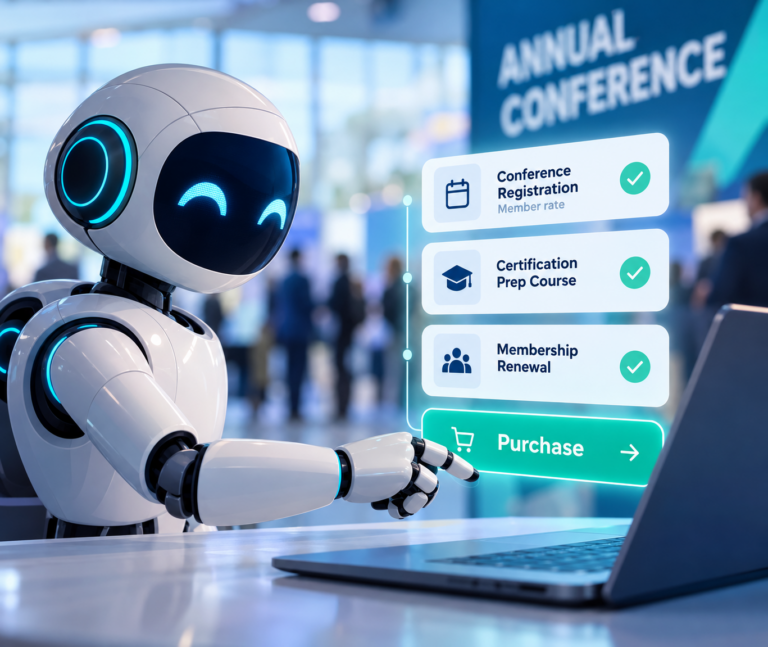
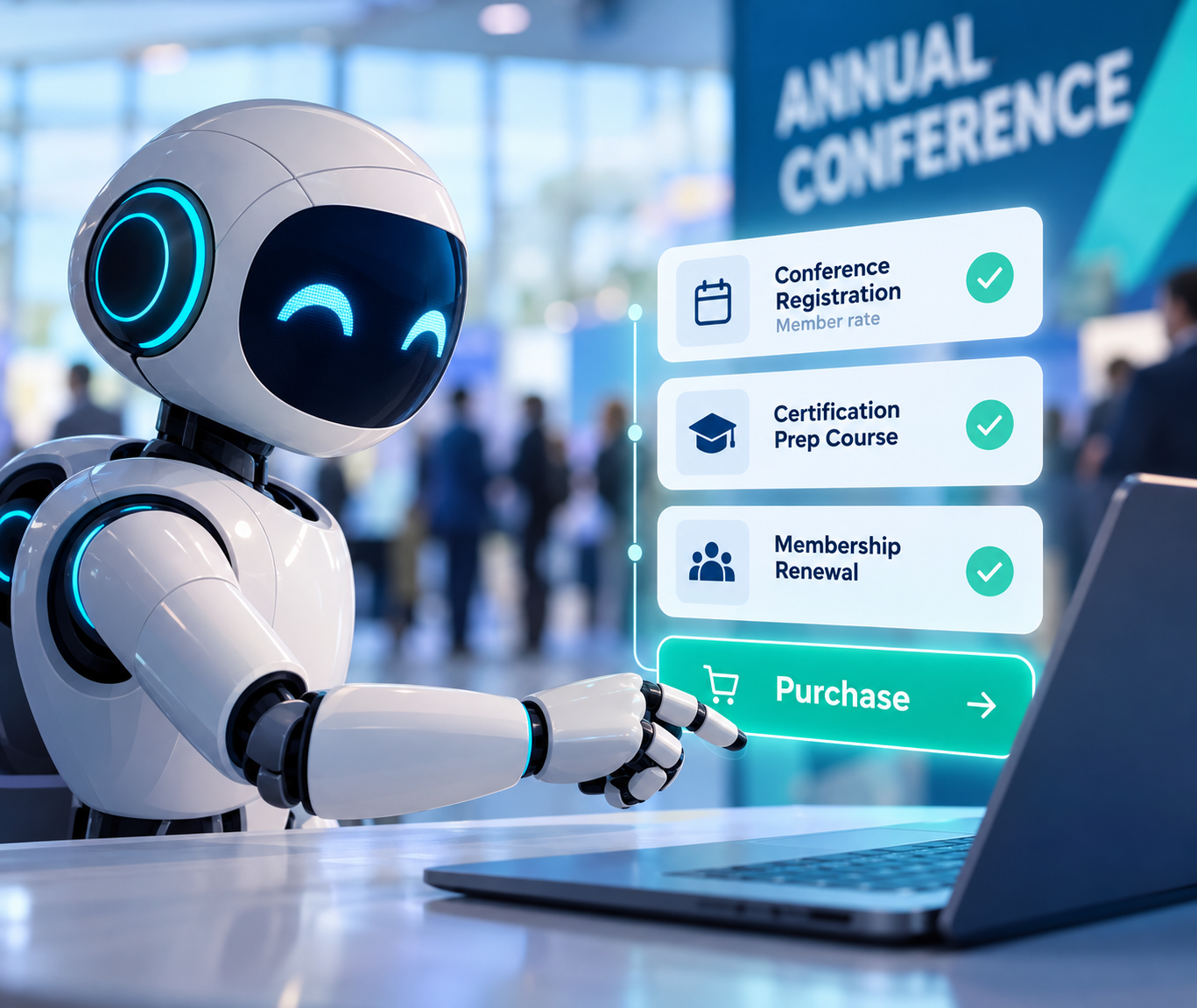
Picture a member typing this into Google: “Register me for my association’s annual conference at the member rate, add the certification prep course, and pay with my usual card.”
A year ago that was a demo. Today Google is building the plumbing to make it routine. Its AI Mode and Gemini assistants can already find, compare and, for a growing list of merchants, buy on a person’s behalf. The question for every association and event organizer in North America is simple. When the agent arrives at your website, can it complete the job?
For most associations I speak to, the honest answer is no. The good news is that there is still time to fix that, but not much.
What changed for agentic commerce this year?
In January 2026 Google launched the Universal Commerce Protocol, or UCP. Think of it as a common language that lets an AI agent read what you sell, build a cart, sign the buyer in and pay. Google built it with Shopify, Etsy, Wayfair, Target and Walmart, and more than 20 others signed on, including Visa, Mastercard, Stripe and American Express.
Three things have happened since.
- Buying moved into the conversation. Google’s own announcement describes shoppers who “research, find, and buy in a single, secure flow without ever leaving the conversation.” It also lets sellers show loyalty and member pricing right inside Google.
- Events got there early. Since November 2025, AI Mode in the US has been able to compare and book event tickets through Ticketmaster, StubHub and SeatGeek. Commercial events are already in the agent’s line of sight.
- The door opened, selectively. On October 6, Google began a gradual US rollout of its UCP hub in Merchant Center, with Canada and Australia to follow in 2027. It is not open enrollment. You build the integration first, register interest, and Google chooses who comes in.
Google is not alone. OpenAI and Stripe launched a rival standard in 2025, and it taught the market a useful lesson. When the checkout inside ChatGPT struggled, OpenAI pulled back in March 2026 and now sends buyers to the seller’s own site. Agents will find you and send you the buyer, but your own website still has to close the sale.
Why will associations feel this first?
Associations sell three things that agents are about to handle a great deal: event registrations, memberships and education. Each one is harder for an agent than a pair of sneakers.
- Registration. Rates depend on who you are. Member, nonmember, student, early bird, group. If that logic sits in a PDF or behind a login, the agent cannot quote it, so it quotes someone else.
- Membership. Joining or renewing usually means choosing a tier, proving eligibility and signing in. An agent needs a clear catalog of tiers and a safe way for the member to let it sign in on their behalf. UCP was designed for exactly this, with member pricing and account linking built in.
- Education and certification. Courses, credits and exam fees compete with commercial training providers whose catalogs are already clean, structured and easy for machines to read.
The risk is not that members stop valuing your conference or your credential. It is that the agent recommends the option it can actually book. A commercial event that an agent can buy in one step will beat an association event that needs nine screens and a password reset.
The timing also matters. Google is choosing merchants now for the US, and Canadian onboarding starts next year. Organizations that do the groundwork in the coming months will be ready when the door opens. Those that wait will be building while their competitors are already selling.
What should associations put in place this quarter?
None of this requires rebuilding your website. It requires making what you already sell legible to a machine and easy to complete.
- Publish your catalog in a form machines read. Every registration type, membership tier and course needs a clear name, price, date and eligibility rule, marked up in the structured formats search engines and agents use. Rate tables in PDFs do not count.
- Make member pricing reachable. Let members link their account to an agent so the right rate applies automatically, without anyone handing over a password.
- Shorten the path to payment. Count the steps from “register” to “paid.” Remove the fields you never use, offer a guest path where you can, and make every required field clear.
- Publish your UCP profile. UCP asks each seller to publish a small file on its website that tells agents what it supports. It is the entry ticket to Google’s program.
- Register interest with Google early. Selection is by Google, and the technical work has to be finished first. Being early is the advantage.
- Ask your platform vendors where they stand. Most associations run registration and membership on a specialist system. Google’s own guidance tells sellers on third party platforms to ask their provider about UCP plans. Ask now, in writing.
- Measure it. Track visits and sales that arrive from AI assistants as their own channel, so you can see the shift as it happens.
How Kabloom Can Help Associations Get Agent-Ready
Kabloom specializes in associations and their events, and we implement agentic commerce for our clients end to end. That covers structured catalogs for registration, membership and education, member account linking, a simpler checkout, the UCP profile and integration, and the conversation with your platform vendors. We do the build and get you ready for Google’s selection.
If your next conference, renewal season or certification launch is on the calendar for 2027, the work starts now. Book a call with our team and we will show you what an AI agent sees today when it tries to buy from you.
The agents are coming either way. Let’s make sure they can find your front door.
Frequently asked questions
What are AI agents that buy?
AI agents that buy are assistants, such as Google's AI Mode and Gemini, that can find, compare and purchase on a person's behalf. For an association, that could mean an agent registering a member for the annual conference at the member rate, adding a certification prep course and paying with their saved card.
What is Google's Universal Commerce Protocol (UCP)?
UCP is a common standard Google launched in January 2026 that lets an AI agent read what a seller offers, build a cart, sign the buyer in and pay. Google built it with Shopify, Etsy, Wayfair, Target and Walmart, and more than 20 others have signed on, including Visa, Mastercard, Stripe and American Express. Member pricing and account linking are built in.
Can any association join Google's UCP program?
Not automatically. Google began a gradual US rollout of its UCP hub in Merchant Center on October 6, 2026, with Canada and Australia to follow in 2027. Sellers must build the integration and publish a UCP profile first, then register interest. Google decides who is admitted.
Why are associations more exposed to AI agents than other sellers?
Association registrations, memberships and courses depend on eligibility, tiers and sign-in. If rates sit in a PDF or behind a login, an agent cannot quote them and will recommend an option it can book instead, such as a commercial event or training provider with a clean, structured catalogue.
What should associations ask their registration and membership platform vendors?
No. Associations need to make what they already sell machine-readable and easy to complete. That means structured data for every registration type, membership tier and course, account linking for member pricing, a shorter path to payment, a published UCP profile and tracking of AI assistant traffic as its own channel.
Do associations need a new website to be ready for AI agents?
No. Associations need to make what they already sell machine-readable and easy to complete. That means structured data for every registration type, membership tier and course, account linking for member pricing, a shorter path to payment, a published UCP profile and tracking of AI assistant traffic as its own channel.