
The short answer
AI email summaries are changing how people read their inboxes. Gmail and Outlook can now summarize conversations, pull out deadlines and answer questions about what is in a mailbox. For associations and event organizers, that raises a simple question: what happens when your audience no longer sees your email the way you designed it? Email marketing has always rested on one assumption. When someone opens a message, they see the subject line, the visuals, the copy and the call to action, and each of them makes the case for your event. An AI assistant changes that. It picks out what it considers relevant and presents it in its own words. The recipient may still learn about the event and may still register, but the path from your message to their decision can look very different.
AI summaries are now part of everyday email
In January 2026, Google announced a new generation of Gemini features for Gmail, including AI conversation summaries and the ability to ask questions about the contents of an inbox. By June, the summaries were rolling out to Gmail users worldwide, on free, paid and Workspace accounts.
In October 2026, Google expanded AI Inbox to paid Workspace users. AI Inbox picks out action items, deadlines and important updates across conversations. For now it works only for users in the United States with English (US) language settings.
Microsoft is moving the same way. Copilot in Outlook can summarize a thread, highlight the important points and help people catch up without reading every message.
Email platforms are turning from tools that display messages into tools that interpret them. For associations, whose campaigns often carry detailed information to busy professionals, that changes the relationship between sender and reader.
What happens when AI reads your email first
Picture an association promoting its annual meeting. The team has spent weeks on the campaign: the education program, the speakers, the networking and the reasons to attend.
Now picture a potential attendee who no longer reads each invitation. They ask their inbox: “Which conferences have registration deadlines coming up?” The assistant finds the relevant messages and returns a short overview with the event name, dates, city and deadline.
That is useful. But the quality of the program, the value of meeting peers and the experience of being there may not survive the summary, and those are often what make someone decide to go.
This is not necessarily bad news. A clear summary can put your event in front of someone who would have scrolled past the original email. It does mean that the message you send and the message your audience takes in are no longer guaranteed to be the same.
Why this matters for associations and event organizers
Email is still the most direct line between an association and its community. Annual meeting invitations, abstract deadlines, renewals, education programs and sponsorship offers all depend on it, and each has a different job. A deadline reminder needs urgency. An invitation needs to show value. A membership campaign needs to explain why belonging matters. A sponsorship offer needs to connect with a partner’s commercial goals.
Decisions to attend usually involve professional relevance, employer approval, travel budgets and competing commitments. An invitation is rarely just dates and links, and the reasons to go are hard to carry in a two line summary.
What event marketers can do now
- Put the essentials in plain text near the top of every email: event name, dates, city, price and the next deadline. Summaries work from the text they can read.
- Avoid image only emails. Text inside an image is invisible to an AI assistant.
- State the main reason to attend in one clear sentence, so it has a chance of making it into the summary.
- Make the subject line and preview text carry the key fact, not just a teaser.
- Keep one clear call to action per email.
Are traditional email metrics telling the whole story?
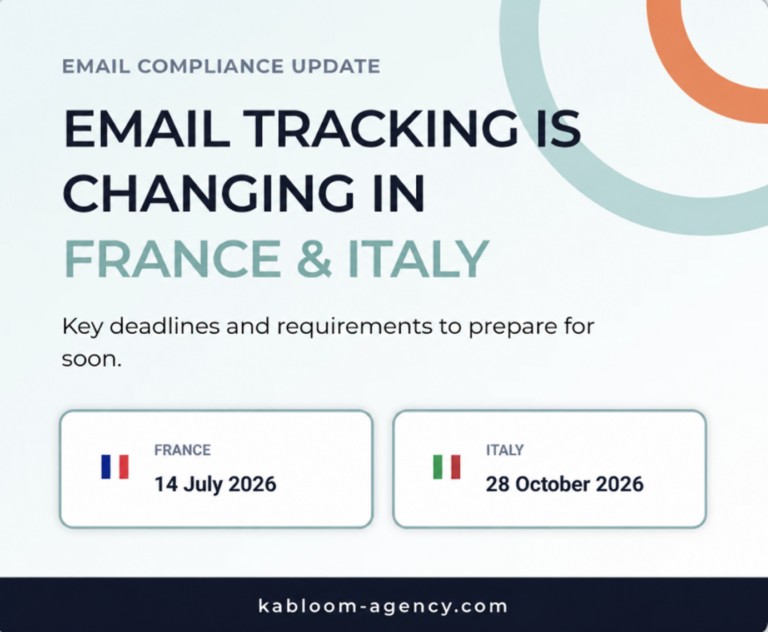
Open rates, clicks, visits and conversions are still useful. But email has never been perfectly measurable, and as we explored in our article on email tracking rules in France and Italy, privacy changes already affect how individual engagement can be tracked.
AI inboxes add another question: could someone learn what they need from a summary without ever engaging with the email the way marketers expect? In some cases, yes. It would be premature, though, to say AI summaries are cutting open rates, clicks or registrations across the industry. The evidence is not there yet.
For Kabloom the principle is simple. Performance should be judged on business outcomes, not on the number of interactions recorded along the way. For associations those outcomes are registrations, membership, engagement and revenue.
Frequently asked questions
Can Gmail AI summarize marketing emails?
Gmail's AI features can summarize conversations and help users find information in their inboxes. How a particular marketing email is handled depends on the feature, the account and the content of the message.
Does Microsoft Outlook offer AI email summaries?
Yes. Copilot in Outlook can summarize email conversations and highlight important information. Availability depends on the account, the subscription and the app.
Will AI email summaries reduce email open rates?
There is not yet enough evidence to say. AI assisted reading may change how people take in information, but its effect on campaign performance is still unknown.
Is email marketing becoming less important for associations?
No. Email still drives registrations, membership engagement and professional communication. AI inbox features change parts of how a message is read, not the value of relevant email.
The future of email marketing is not just about being opened
Getting the right message to the right audience at the right time still matters. What has changed is that email platforms now help decide which parts of that message reach the reader.
That is no reason to tear up what works. It is a reason to watch how reading habits change and to write emails whose key facts can stand on their own.
At Kabloom, we help associations and event organizers turn digital marketing into measurable registrations, membership growth and revenue. The future of email marketing may not be about getting people to read every word. It may be about making sure what matters survives the summary.
Sources
- Google Workspace: Gmail’s AI Inbox is rolling out to paid Workspace users, October 2026
- Google Workspace: Expanding Gemini in Gmail to more Workspace users, November 2026
- eWeek: Google rolls out Gmail AI Summaries to users worldwide, June 2026
- Microsoft: Summarize an email thread with Copilot in Outlook